
Enterprise marketing teams face a specific version of the approval workflow problem. It is not simply a matter of getting sign-offs faster. It is about managing simultaneous campaigns across multiple brands or regions, maintaining documented compliance across legal, regulatory, and brand review stages, and doing all of this without losing visibility across a team that may span dozens of people, multiple agencies, and external stakeholders in different time zones.
The tools that work for a 10-person in-house studio often fail at that scale. General project management platforms — built for task tracking across any kind of work — rarely provide what enterprise marketing teams actually need: markup on creative assets, multi-round revision tracking, compliance checklists, audit trails, and brief-to-sign-off governance in one place.
This guide compares the leading marketing approval workflow software for enterprise teams — evaluated against eight criteria that matter at scale. Not yet familiar with how marketing approval workflows work? Start with our complete guide to marketing approval workflows before diving into the comparison.
Why Enterprise Marketing Approval Processes Break Down
Understanding where approval processes fail at enterprise scale is the starting point for choosing a platform that actually solves the problem. The most common failure points follow a consistent pattern across organisations of every size.
-
Email-based review creates uncontrollable version spread When feedback arrives across email threads, shared drives, and messaging platforms, creative teams are routinely working from outdated files. There is no single source of truth, and the approval record — if one exists at all — is buried in inboxes rather than tied to a specific asset version.
-
Sign-off chains have no enforcement mechanism Without a structured workflow, legal and compliance review becomes optional in practice. Campaigns ship without completing mandatory sign-off stages because there is no system preventing it — only process documentation that is easy to bypass under deadline pressure.
-
External reviewer access is uncontrolled Agencies and legal teams receive assets via email or shared links with no version control, no deadline tracking, and no audit trail. When a regulator asks who reviewed a specific version of a campaign asset and when, the answer is often buried in an email thread.
-
Multi-brand complexity overwhelms single-template workflows An approval process designed for one brand breaks down when applied across multiple brands with different compliance requirements, different stakeholder structures, and different review timelines. Teams end up running ad hoc processes per brand that are impossible to audit or standardise.
-
Approval tools are disconnected from production When briefing, project management, and approval workflow live in separate tools, the handoffs between them create version gaps, accountability gaps, and visibility gaps that no amount of manual coordination fully closes.
-
No visibility across simultaneous campaigns Enterprise teams running hundreds of concurrent campaigns have no way to see aggregate approval status, bottlenecks, or overdue reviews without manual reporting — by which point the deadline has already passed.
The core problemMost enterprise teams are not running a broken approval process — they are running no consistent approval process at all. Different brands, teams, and campaigns use different approaches. Marketing approval workflow software solves this by making governance systematic, auditable, and enforceable rather than relying on individual discipline. |
What to Look for in Enterprise Marketing Approval Workflow Software
The eight criteria below separate purpose-built governance platforms from project management tools with approval features added. For regulated industries and multi-brand environments, the distinction is significant — and often the difference between a defensible audit trail and a compliance gap.
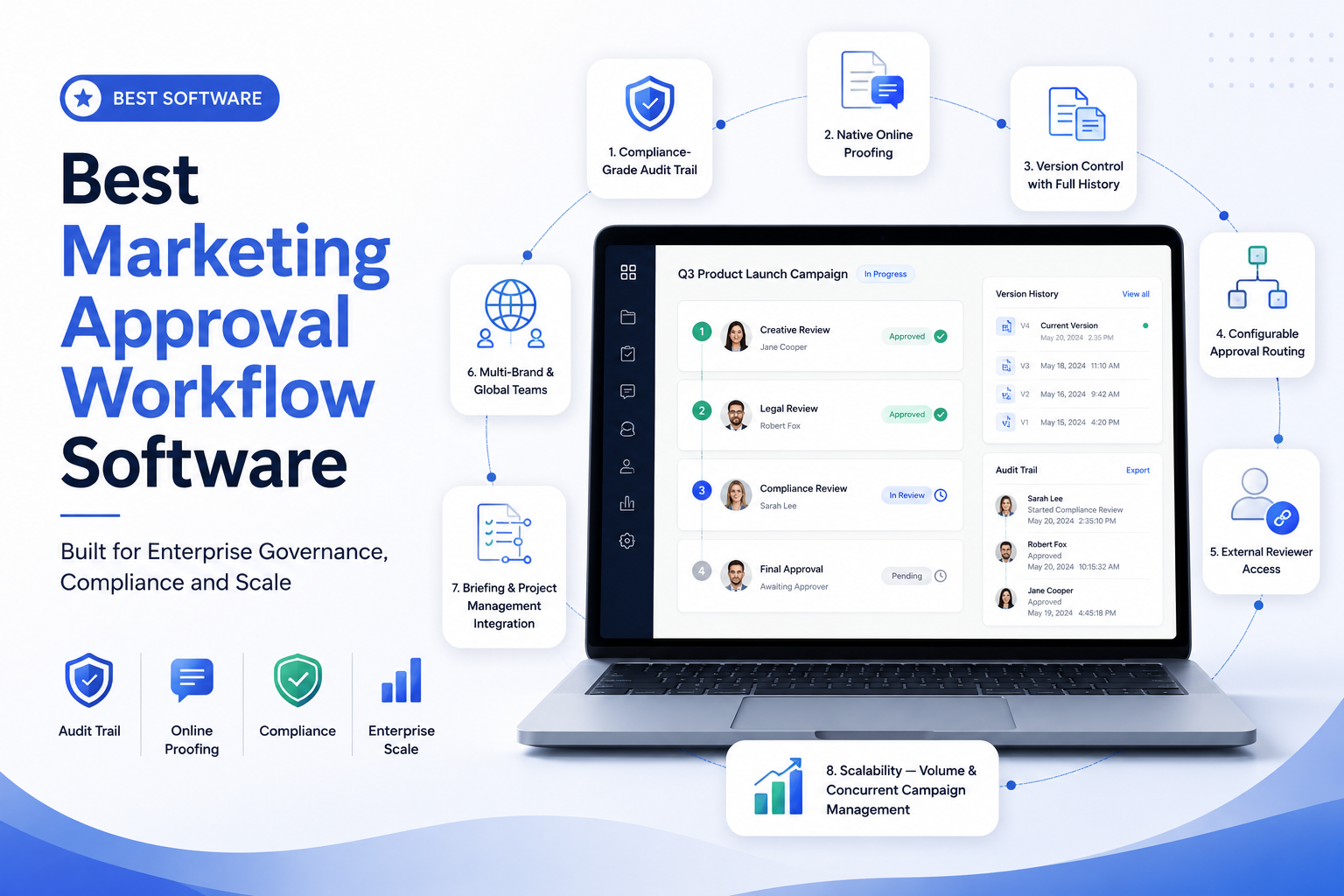
1. Compliance-grade audit trail
The most important criterion for regulated-industry teams, and the most commonly misrepresented. A genuine compliance-grade audit trail is immutable — entries cannot be edited or deleted, including by administrators. It is user-attributed at an individual level, timestamped to the second, version-linked so each approval record is tied to a specific asset version rather than just an asset name, and exportable in a format suitable for regulatory or legal review.
For Australian enterprises in financial services, insurance, health, and pharmaceutical marketing, this is a regulatory requirement, not a reporting feature. A basic activity log — the kind found in general project management tools — does not meet this standard. See: marketing compliance software.
2. Native online proofing — not integrated
Online proofing means reviewers annotate, mark up, and comment directly on the creative asset inside the platform — without downloading files or switching to a separate tool. For enterprise teams managing diverse asset types, native proofing across images, PDFs, video, HTML banners, and rich media is essential.
The distinction between native and integrated proofing matters significantly. When a platform relies on a third-party proofing integration, version control risk increases, notification gaps appear, and the audit trail may be split across two systems — creating a compliance gap for regulated industries. See: Simple's online proofing solution.
3. Version control with full asset history
Every iteration of an asset should be stored, labelled, and linked to the approval decisions made at that iteration. The ability to answer — who approved which version, when, and what changed between rounds — is what makes a version control system genuinely useful for enterprise governance rather than just file storage.
Side-by-side version comparison, the ability to restore previous versions, and the linkage between each version and its approval record are the capabilities that separate enterprise-grade version control from basic file versioning.
4. Configurable approval routing — sequential, parallel, and conditional
Enterprise approval chains are rarely linear. A campaign might require sequential sign-off from the creative director, then legal, then compliance — but simultaneously from two regional brand managers who can approve in parallel. Conditional routing — automatically escalating to legal only when a regulated claim or specific asset type is present — is essential for managing this complexity without manual coordination.
Approval path templates configurable by brand, market, or campaign type are what make governance enforceable at volume. Without them, teams either rebuild approval chains on every project or apply a generic process that does not reflect the actual compliance requirements of each brand.
5. External reviewer access — without a full licence
Enterprise teams involve external parties at every approval stage: agencies, legal counsel, regulatory reviewers, and client-side stakeholders. External reviewer actions must be captured in the same audit trail as internal approvals — a split record where external review happens outside the platform creates a compliance gap that cannot be closed retrospectively.
6. Multi-brand and global team support
The platform must support configurable approval paths per brand and market, role-based access that reflects brand-specific team structures, and time-zone-aware notifications and deadline management for distributed review teams. Multi-brand configuration means distinct governance rules running simultaneously — not simply multiple projects in the same workspace with the same workflow applied to each.
7. Briefing and project management integration
Approval workflow sits at the end of a production process that starts with a brief. Platforms that integrate approval workflow with brief management and project management eliminate hand-off gaps and give marketing operations a single source of truth across the campaign lifecycle — from brief through to compliance sign-off. This is what separates platforms like Simple Admation from standalone proofing tools or project management platforms with approval tasks added.
8. Scalability — volume and concurrent campaign management
Enterprise teams may have hundreds of active projects simultaneously across multiple brands, markets, and agency partners. Purpose-built marketing workflow platforms are architected for production volume. General project management tools adapted for approvals — or platforms built primarily for small-to-mid-size teams — typically hit performance and structural limits at enterprise scale.
Questions to ask every vendor before shortlisting
|
Quick Comparison: Enterprise Marketing Approval Platforms
Eight platforms compared across nine criteria — purpose-built marketing approval tools alongside project management platforms commonly considered by enterprise teams. The full comparison table is on the following page.
Enterprise Marketing Approval Software — Feature Comparison
|
Platform |
Audit Trail |
Online Proofing |
Version Control |
Approval Routing |
External Review |
Multi-Brand / Global |
Regulated Industry Fit |
Setup Complexity |
Best For |
Simple Admation |
✅Immutable, exportable, version-linked |
✅ Native — images, video, PDF, HTML |
✅ Full history, side-by-side comparison |
✅Sequential, parallel, conditional — templateable by brand |
✅ Secure guest links — captured in audit trail |
✅ Custom brand/market templates, global campaign visibility |
✅ Financial services, health, insurance, retail, pharma |
Low |
Enterprise marketing governance in regulated industries |
Adobe Workfront |
✅ Full — configurable for compliance |
⚠️ Via Workfront Proof module (separate) |
✅ Full |
✅ Multi-step, conditional |
⚠️ Requires licence configuration |
✅ Strong — enterprise global scale |
✅ Yes — broad enterprise |
High |
Large enterprises in the Adobe ecosystem |
Ziflow |
✅ Full activity log per proof |
✅ Native — widest format support |
✅ Full, side-by-side comparison |
✅ Multi-stage, conditional |
✅ Guest reviewer access |
⚠️ Limited brand-level config |
✅ Yes — SOC2, SSO |
Low–Medium |
High-volume creative review — proofing-first workflows |
Monday.com |
⚠️ Activity log only — not compliance-grade |
⚠️ Via Ziflow integration — not native |
⚠️ Basic file versioning only |
✅ Multi-step with automation |
✅ Guest access available |
⚠️ Limited brand-level config |
⚠️ Platform acknowledges compliance limitations for regulated industries |
Low |
Teams using Monday for project management needing light-touch approvals |
Wrike |
⚠️ Activity log — not compliance-grade |
❌ No native creative proofing |
⚠️ Basic file versioning only |
✅ Multi-step with automation |
✅ Guest access available |
✅ Good — integrates with enterprise tools |
⚠️ Not purpose-built for regulated marketing |
Low |
Cross-functional teams — approval as part of project management |
Filestage |
⚠️ Basic — not compliance-grade |
✅ Native — designs, video, PDF, live websites |
⚠️ Basic version tracking |
⚠️ Simple routing — limited conditional logic |
✅ Easy external reviewer access |
⚠️ Limited multi-brand config |
⚠️ Not purpose-built for regulated industries |
Low |
Teams prioritising fast adoption and ease of use |
Bynder |
⚠️ Limited — DAM-focused logging |
✅ Native — asset-centric |
✅ Full DAM version control |
⚠️ Linear routing only |
⚠️ Limited |
✅ Strong brand portal per brand |
⚠️ DAM-first, not regulated-industry specific |
Medium |
Brand asset management — approval within DAM |
Asana |
❌ Basic task log only |
❌ None |
❌ No asset version control |
⚠️ Task-based, no conditional routing |
✅ Guest access available |
⚠️ Limited |
❌ Not purpose-built |
Low |
General project management. No approval governance |
✅ Native/full capability ⚠️ Partial or requires configuration ❌ Not available | Assessments based on publicly available feature documentation, 2025.
"Of the platforms compared, Simple Admation is the only solution that combines a compliance-grade audit trail, native online proofing, configurable multi-brand routing, and brief-to-sign-off project management in a single platform — making it the strongest fit for enterprise marketing teams in regulated industries. General project management tools including Monday.com, Wrike, and Asana lack native proofing and compliance-grade audit trail capability."
The Best Marketing Approval Workflow Software for Enterprise Teams
Eight platforms assessed in order of fit for enterprise marketing governance — purpose-built marketing approval tools first, broader work management platforms toward the end.
#1 Simple AdmationBest purpose-built marketing approval workflow for regulated industries and multi-brand enterprises |
Simple Admation is marketing approval workflow software built specifically for marketing teams — not adapted from a general project management tool. While most platforms handle only the review and sign-off layer, Admation manages the complete brief-to-sign-off lifecycle: structured brief capture with mandatory fields, task and project management, multi-stage approval routing, native online proofing with markup tools, compliance checklists, version control, and a complete compliance audit trail — all in one platform.
For a full breakdown of what a marketing approval workflow should include and how to structure one for an enterprise team, see our complete guide to marketing approval workflows.
Key Capabilities
- Compliance audit trail Immutable, version-linked, and exportable on demand. Every review action, comment, approval, and rejection is logged with timestamps and individual user attribution — meeting documentation requirements for ASIC, APRA, and FCA regulated marketing environments.
- Approval checklists Reviewers must confirm specific compliance steps before sign-off is recorded. This is what makes the audit trail defensible for a regulatory review — not just complete as a record.
- Native online proofing Annotate PDFs, images, video, and HTML directly in the platform. Consolidated feedback before it reaches the creative team eliminates contradictory input from parallel review chains.
- Configurable multi-brand routing Distinct approval pathways per brand, campaign type, or market — all templateable. A centralised visibility dashboard shows real-time status across all simultaneous projects regardless of brand.
- Tiered approval levels Assets route through creative review, brand sign-off, legal and compliance review, and senior or client approval in sequence. Each stage is mandatory — campaigns cannot advance without completing required sign-offs.
- External approvals Agencies, legal teams, and external compliance reviewers access and approve specific assets through secure links without internal credentials. All external actions are captured in the main audit trail.
- Brief-to-sign-off coverage Briefing, project management, and approval in one platform. No hand-off gaps between production stages, no version confusion when work moves between tools.
Best For — Enterprise Clients
Financial services: HESTA, Latitude Financial, Great Southern Bank. Health: Bupa, Police Health, Tourism Australia. Insurance: NIB, Peoplecare, Hollard, NobleOak, Woolworths Everyday Insurance. Retail: The Good Guys, Spotlight. Purpose-built for environments where compliance documentation and approval accountability are as important as speed to market.
Limitations
Admation is a specialist marketing platform — it is not a general work management tool. Teams needing broader business operations coverage such as HR workflows, procurement, or IT project management will need a separate solution for those use cases.
→ Explore Simple Admation's marketing approval capabilities
→ Complete guide to marketing approval workflows
#2 Adobe WorkfrontBest for large enterprises already embedded in the Adobe ecosystem |
Adobe Workfront is an enterprise work management platform that brings project management, resource allocation, and approval workflows into one environment. Its primary strength for enterprise marketing teams is native integration with Adobe Creative Cloud — designers push work into review directly from Creative Cloud applications.
Key Capabilities
- Adobe Creative Cloud integration Assets route from Creative Cloud directly into review cycles without file transfer or tool switching.
- Multi-step approval routing Conditional routing with delegation and escalation paths for large cross-functional team structures.
- Enterprise reporting Workload management, project tracking, and approval velocity reporting.
- Compliance configuration Audit logging configurable for compliance requirements — though setup requires more investment than purpose-built solutions.
Limitations
Online proofing requires the separate Workfront Proof module — it is not native to the core platform. Implementation complexity and pricing are enterprise-tier, and for teams whose primary need is marketing approval governance rather than end-to-end work management, Workfront is often more platform than the use case requires.
#3 ZiflowBest dedicated online proofing platform for high-volume creative review |
Ziflow is purpose-built for creative review and online proofing at scale. Its strength is the breadth and quality of proofing tools — reviewers annotate PDFs, images, video, audio, HTML, and live websites within a single interface. Named clients include McDonald's and Royal Mail.
Key Capabilities
- Widest file format support Video, audio, HTML, live websites, images, PDFs — the broadest proofing format coverage in this category.
- Frame-accurate video annotation Side-by-side version comparison and granular markup tools for precise creative feedback.
- ReviewAI (2025) AI-assisted checklist verification reduces manual QA time for repetitive compliance checks.
- Enterprise security SOC2 compliant, SSO support, granular permissions.
- Audit trail Complete activity log per proof, review, and approval decision.
Limitations
Ziflow covers the review and proofing stage only — no brief capture, project management, or full campaign workflow governance. Enterprise teams typically need to connect Ziflow with a separate project management tool, and the audit trail does not cover the production stages outside of Ziflow's proofing environment.
#4 Monday.comBest for teams already using Monday for project management who need light-touch approval tracking |
Monday.com is a visual work management platform widely used across enterprise organisations for project tracking, campaign management, and team coordination. Its approval features are built into its task and automation architecture — when tasks reach defined statuses, approval routing triggers automatically without manual handover.
For enterprise marketing teams already running campaigns on Monday.com, the platform offers a convenient way to add structured approval steps without introducing a separate tool for lighter-touch workflows.
Key Capabilities
- Embedded approval automation Multi-step approval routing triggered by task status changes, with automated notifications to approvers.
- Conditional automation rules Approval flows configurable based on conditions such as campaign type or status — built using Monday's no-code automation builder.
- Enterprise integrations Connects to Adobe Creative Cloud, Microsoft Teams, Google Drive, Salesforce, and hundreds of other enterprise tools.
- Portfolio visibility Cross-project campaign visibility and workload management for marketing operations leaders.
- Online proofing via Ziflow Monday's official proofing integration brings review and annotation capability into the platform — though it requires a separate Ziflow subscription.
Limitations
Monday.com has no native online proofing — creative asset markup requires the separate Ziflow integration, meaning the proofing record and the project record sit in different systems. Monday's own documentation acknowledges that complex compliance requirements with detailed audit trails exceed what the platform's automation layer provides without additional integration.
There is no compliance-grade audit trail — approval activity is logged at task level, not tied to specific asset versions. For enterprise marketing teams in regulated industries where approval records must be immutable, exportable, and version-linked, Monday.com is not a purpose-built solution. Teams that grow beyond light-touch approvals typically find they need to add dedicated marketing governance tooling alongside it.
#5 WrikeCross-functional project management with approval embedded — limited compliance depth |
Wrike is a work management platform with approval workflow features built into its project management architecture. For teams managing cross-functional campaigns where approval is one component of a broader project management requirement, Wrike's combination of Gantt charts, resource management, and embedded approval routing reduces the need for a separate tool at the project management layer.
Key Capabilities
-
Embedded approval routing Approvals trigger automatically when tasks reach defined statuses.
-
Automation rules Custom automation for task assignment, status changes, and approval triggers.
-
Enterprise integrations Adobe Creative Cloud, Microsoft Teams, Google Drive, Salesforce.
- Portfolio visibility Cross-project campaign visibility for marketing operations leaders.
Limitations
No native creative proofing, no compliance-grade audit trail, and no version control designed for marketing asset governance. Approval is task-based — reviewers approve tasks, not annotated creative files. For teams in regulated industries, Wrike does not provide the documentation architecture required for compliance sign-off.
#6 FilestageLightweight review and approval — best for teams prioritising fast adoption |
Filestage is a review and approval platform designed for clarity and ease of use. Reviewers comment directly on designs, videos, PDFs, and live websites with simple status tracking. Its primary advantage is adoption speed — large teams managing change management alongside a software rollout often find Filestage the fastest to get running.
Key Capabilities
- Broad file type support Designs, video, PDFs, live websites — reviewers annotate directly in the platform.
- Simple status tracking Clear visibility of where each asset sits in the review process.
- External reviewer access Easy guest access without licence requirements.
- Integrations Slack, Asana, Trello, and cloud storage providers.
Limitations
Filestage covers the review stage only — no brief capture, project management, or full marketing workflow governance. Compliance documentation capabilities are lighter than purpose-built regulated-industry platforms. Approval routing logic is simple and lacks the conditional routing and compliance checklist architecture that financial services, insurance, and pharma marketing teams require.
#7 BynderBest for brand asset management teams needing approval workflow within their DAM |
Bynder is primarily a digital asset management platform with workflow and creative approval features designed to support the asset creation and distribution lifecycle. For teams whose approval workflow is asset-centric — reviewing and approving creative for brand library ingestion — Bynder offers a convenient single-platform approach.
Key Capabilities
- Brand portal per brand Strong brand portal and asset distribution features with approval workflows designed around asset finalisation.
- Creative workflow Approval routing with annotation tools built into the DAM interface.
- Brand guidelines integration Approved assets flow directly into the brand library.
Limitations
Approval workflow is purpose-built for the asset-to-DAM flow, not end-to-end marketing campaign governance. Compliance audit trail depth and configurable multi-step routing are not as robust as dedicated approval workflow platforms. For regulated industries or complex multi-stakeholder campaign approvals, Bynder's workflow layer is insufficient as a standalone solution.
#8 AsanaGeneral project management — not purpose-built for marketing approval governance |
Asana is a widely adopted work management platform with approval features introduced as part of its task and project management architecture. Marketing teams sometimes configure approval tasks within Asana — though this is a workaround rather than a native marketing governance capability.
Key Capabilities
- Task-based approval tracking Reviewers mark tasks approved or request changes within Asana's workflow builder.
- Portfolio views Cross-project visibility for teams managing multiple campaigns simultaneously.
- Integration ecosystem Wide range of marketing tool integrations via native connections and Zapier.
Limitations
No native online proofing, no version control for creative assets, and no compliance-grade audit trail. Approval is task-based and does not capture asset-level review decisions tied to specific versions. For enterprise marketing teams in regulated industries, Asana's approval tracking is insufficient as a primary governance solution.
How to Choose: Matching the Platform to Your Enterprise Need
The right platform depends on which governance challenge is most critical and what your team is already using. Use this framework to shortlist:
Ask every vendor: is your audit trail immutable, version-linked, and exportable? Can it be produced for a regulatory review tomorrow? The answer immediately distinguishes platforms built for marketing governance from those that have added approval features to a broader project management tool. |
Frequently Asked Questions
What makes it hard to manage marketing approval workflow software for enterprise teams?
The most common difficulties are: email-based feedback creating uncontrolled version spread across creative teams, sign-off chains with no enforcement mechanism so mandatory review stages are bypassed under deadline pressure, external reviewer access that produces no audit trail, multi-brand complexity that overwhelms single-template workflows, and approval tools disconnected from production briefing and project management. These are structural problems that require a platform enforcing governance rules automatically — not more process documentation.
How do large teams streamline marketing approval workflow software processes?
Large teams streamline approval processes by replacing ad hoc email review with a structured platform that enforces routing, automates notifications, tracks asset versions, and generates a complete audit trail without manual coordination. The key enablers are configurable approval path templates so teams are not rebuilding workflows per project, conditional routing that automatically escalates to legal or compliance when required, and a centralised dashboard giving marketing operations visibility across all simultaneous campaigns. Purpose-built marketing approval platforms achieve this without the configuration overhead of adapting a general project management tool.
What is the best marketing approval workflow software for compliance?
Simple Admation is specifically designed for compliance-grade marketing approval — with immutable, version-linked audit trails exportable for regulatory review, mandatory approval checklists, and tiered sign-off that prevents campaigns advancing without completing required stages. It is used by Australian marketing teams operating under ASIC, APRA, and FCA requirements including HESTA, NIB, Bupa, and Latitude Financial. See: marketing compliance software.
What is the best marketing approval workflow software for global teams?
For global teams, the key requirements are time-zone-aware notifications and deadline management, secure external reviewer access for distributed agencies and legal teams, centralised visibility across simultaneous campaigns in multiple markets, and configurable routing per market or brand. Simple Admation addresses all of these through configurable multi-brand and multi-market approval path templates, secure external guest access captured in the audit trail, and a centralised campaign visibility dashboard across all active projects regardless of market or brand.
What is the best marketing approval workflow software for multi-brand retail organisations?
Simple Admation supports distinct approval pathways and compliance requirements per brand, with a centralised campaign visibility dashboard across all simultaneous projects. Approval path templates are configurable by brand, campaign type, or product line — so each brand runs its own governance process without manual reconfiguration on every project. Enterprise retail clients include The Good Guys and Spotlight. See: retail marketing workflow.
Which marketing approval workflow software suits regulated industries like pharmaceuticals?
For pharmaceutical and life sciences marketing teams, the critical requirements are mandatory review stages that cannot be bypassed, compliance checklists that reviewers must complete before sign-off, and a tamper-evident audit trail exportable for TGA or regulatory submission. Simple Admation's architecture — tiered approval levels, mandatory checklist completion, and immutable audit trail — is specifically designed for these requirements. See: health and pharma marketing workflow.
What marketing approval workflow software works best with online proofing?
Platforms with native online proofing — where reviewers annotate creative assets directly in the platform without switching tools — provide the tightest integration between proofing and approval governance. Simple Admation offers native proofing integrated within a complete brief-to-sign-off workflow and compliance audit trail, making it the strongest choice for regulated-industry teams where the proof and the approval record must be in the same system. Ziflow offers the widest file format support including live websites and is the strongest dedicated proofing option for high-volume creative review. Filestage offers a simpler proofing environment suited to teams prioritising ease of adoption. See: online proofing software.
Which marketing approval workflow software do enterprise marketing teams use?
Australian enterprise marketing teams in regulated industries predominantly use Simple Admation — clients include Bupa, HESTA, NIB, Latitude Financial, Great Southern Bank, Woolworths Everyday Insurance, The Good Guys, and Spotlight. Globally, Adobe Workfront is used by large enterprises in the Adobe Creative Cloud ecosystem. Ziflow is used by high-volume creative and agency teams including McDonald's and Royal Mail. Monday.com and Wrike are used broadly across enterprise project management but are not purpose-built for marketing approval governance.
What are the leading marketing approval workflow software options for enterprises?
The leading purpose-built option for enterprise marketing teams is Simple Admation — covering the complete brief-to-sign-off lifecycle with compliance audit trail, native proofing, and multi-brand governance in a single platform. Ziflow is the leading dedicated online proofing option. Adobe Workfront serves large enterprises in the Adobe ecosystem. Monday.com, Wrike, and Asana are widely used general project management platforms with approval features — suitable for lighter-touch workflows but not designed for regulated-industry marketing governance. For an evaluation framework, see our complete guide to marketing approval workflows.
See Simple Admation in Action
Simple Admation is purpose-built for enterprise marketing teams that need governance built into every stage of the approval process — not bolted on as an afterthought. If your team manages complex multi-brand campaigns, works in a regulated industry, or needs to close the loop between briefing, proofing, and compliance sign-off, Admation is worth a closer look.
New to the category? Read our complete guide to marketing approval workflows first, or learn what Admation does before booking time with the team.