
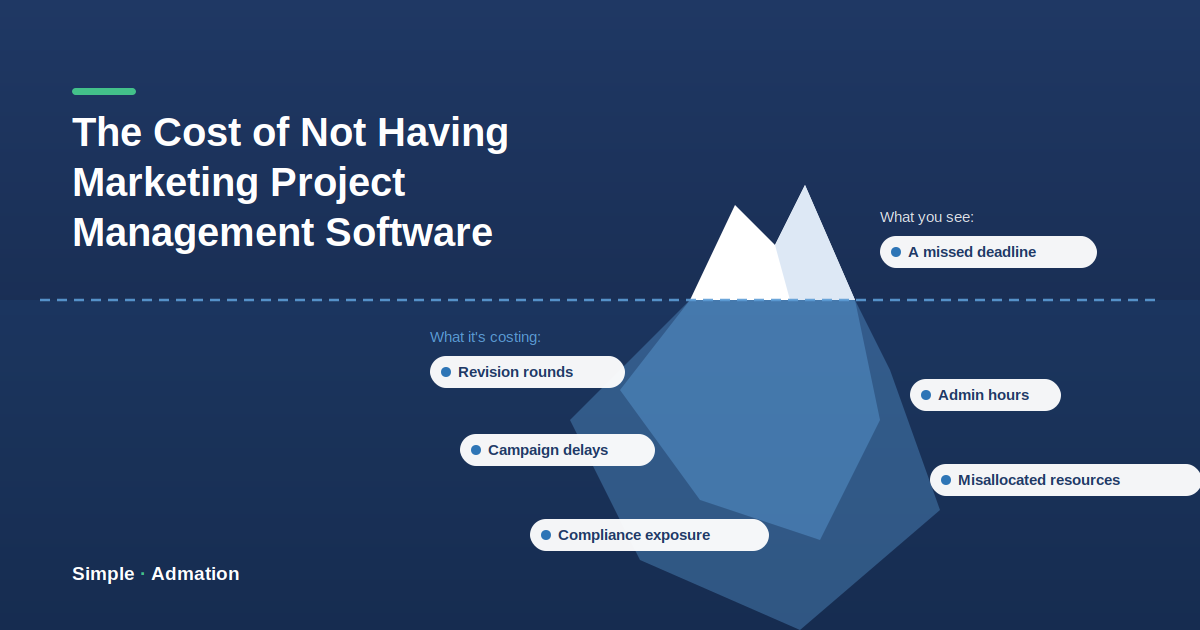
The cost of not having marketing project management software isn't a line item — it's paid continuously in delayed projects, excessive artwork revisions, hours lost to spreadsheet admin, misallocated resources and compliance exposure. This post breaks down the six places that cost accumulates. Simple Admation is marketing project management software built to remove each of them, consolidating briefing, approvals, resourcing and asset management into one platform.
As the marketing industry grows increasingly fast-paced, with the expectation of producing more content and campaigns across a growing number of channels, burnout is becoming more common and marketer turnover with it. Adopting the right tools, processes and culture to support marketing and creative teams is no longer optional. Businesses still relying on outdated systems such as email and spreadsheets, and managing projects without dedicated tools, need to consider what those inadequate tools are actually costing them.
1. A lack of cohesion delays marketing projects
Is your typical week plagued by briefs submitted with little information and sent to the wrong person? Do you struggle to find available resources for urgent tasks due to uncertainty over the accuracy of your resource spreadsheet? Are you lacking transparency over projects, making it difficult to update your manager without having to ask around first? Do approvals get delayed due to constant changes, leaving you unsure if you'll meet your deadline?
Project management software alleviates these issues by consolidating every aspect of your projects into one platform. All files and documents live in one place, creating an automatic audit trail of work and letting you track who has completed what. Everything from briefing and resourcing through to approval workflow management and final asset storage runs through the same system — the delays caused by information living in six places disappear with the six places.
2. Email approvals lead to high artwork revisions
Email approvals routinely produce multiple revisions to artwork, causing delays and wasted resources. While email works for simple messages, it falls apart when collecting feedback from multiple reviewers across several deliverables: numerous threads, missed changes, versions that are difficult to track, and conflicting feedback that reaches the designer unreconciled.
In contrast, online proofing provides a single collaborative interface for gathering feedback. Approved reviewers log in, mark up artwork directly, and add clear text comments. All changes are visible to all reviewers, so conflicts get resolved before they cost a revision round. When feedback is final, it's batched to the creative team in one communication. Every unnecessary revision round this prevents is designer time bought back.
3. The daily grind of spreadsheets
Many marketers and project managers still plan and track projects in spreadsheets. Every change means a manual update; every stakeholder update means a new version distributed by email. This labour-intensive routine steals hours from every week — and the spreadsheet is still wrong the moment anything changes. (We've counted the ways in why Admation beats spreadsheets for managing marketing projects.)
The alternative: set a project up once and have it appear on a real-time dashboard. Status icons show how projects are progressing, assigned resources are notified automatically, and approved users check progress themselves instead of requesting it. If someone wants a WIP report, it's generated in seconds rather than assembled by hand.
4. Losing creative time to repetitive admin
Traditional tools for content production carry a constant administrative tax: poor briefing that needs follow-up, manual spreadsheet updates for project and resource scheduling, hard-to-interpret handwritten markups, lengthy email trails, and endless chasing of stakeholders for feedback.
Marketing project management software removes that tax by automating the repetitive layer: online brief and approval templates, a centralised dashboard, task lists, resource planning tools, automatic reminders and reporting. The hours this recovers go back where they earn — into the creative work itself. Teams that make the switch consistently report that recovered creative time is the benefit they feel first.
The arithmetic is worth making explicit: administrative chasing is paid at creative and management salaries, and it compounds — a designer interrupted to hunt for the current version loses the interruption and the refocus time, and a traffic function built on spreadsheets scales its admin linearly with every project added. That's the quiet mechanism behind teams feeling busier while shipping less.
5. Lack of resource visibility leads to errors in resource allocation
Using spreadsheets to manage resources invites errors: double bookings, idle capacity nobody can see, and no fast way to assign or reassign work when urgent jobs land.
Integrated resource management provides the missing visibility. Planning and scheduling tools show complete resource capacity, drag-and-drop reassignment moves work in seconds, and the system flags problems — like a workload meter hitting 100% — before they become missed deadlines. Stakeholders can view capacity for upcoming projects themselves, without interrupting the team to ask.
6. Compliance issues occur when old assets are used in campaigns
If brand assets aren't filed in an organised way, it's easy for a designer to grab the wrong version. An old brand asset used in a campaign is an internal compliance issue; old messaging going public can become an external one — and in regulated industries, an expensive one.
For Australian companies, the regulatory numbers make this the costliest category on this list. The ACCC's penalty against Qantas for misleading conduct reached $100 million; ASIC's greenwashing actions have produced penalties of $11.3 million (Mercer), $12.9 million (Vanguard) and $10.5 million (Active Super); and Australian legislation passed in March 2026 doubles maximum penalties for misleading marketing conduct. Against those figures, the informal approval process that let outdated or unapproved messaging reach market stops being an operational inconvenience and becomes a board-level risk.
Project management software with integrated digital asset management ensures only current, approved assets are available for campaigns. Licensed imagery triggers automated reminders when the licence expires, and download history shows exactly who has accessed which assets. The compliance incident that never happens is the cheapest one.
How to Estimate What Your Current Process Costs
Because none of these costs is invoiced, the way to make the business case is to estimate them from your own numbers. Five questions produce a defensible figure:
| Cost category | How it's paid | Estimate it from |
|---|---|---|
| Revision rounds | Designer and reviewer hours per extra round, plus delay days | Average rounds per deliverable × deliverables per month × hours per round |
| Status and admin | Hours maintaining spreadsheets, chasing approvals, assembling reports | Hours per week per person on manual updates and chasing × salaries |
| Campaign delays | Missed launch windows, compressed media schedules, rush fees | Projects delivered late last quarter and what each slip cost |
| Resource misallocation | Overtime and contractor spend alongside idle internal capacity | Contractor invoices and overtime against actual utilisation |
| Compliance exposure | Incident remediation — or the penalty itself in regulated sectors | Near-misses in the last year, weighted by your regulatory environment |
Most teams that run this exercise find the first two categories alone — revision rounds and administrative chasing — exceed the annual cost of the software. The remaining three are the asymmetric risks: infrequent, but each individually capable of dwarfing the tooling budget. Put your own numbers against the table and the "do nothing" option acquires the price tag it always had. When you're ready to evaluate the tools themselves against these cost categories, we compare the leading options in the best marketing project management software guide.
Counting the Real Cost
None of these six costs appears on an invoice, which is why they persist: delayed campaigns, paid-for revision rounds, admin hours at creative salaries, misallocated capacity, and compliance exposure all bill quietly. Their common cause is the same — work fragmented across email, spreadsheets and shared drives — and so is their fix.
Simple Admation consolidates the whole workflow: Admation's online briefs capture complete information up front, its online proofing collects and reconciles feedback on the asset, its resource planner allocates work against real capacity, its approval pathways and audit trail keep sign-off compliant, and its asset library keeps campaigns running on current, approved files. It's the model Tourism Australia runs for its global in-house studio — the full story is in the Tourism Australia case study. For why teams reach this point, see why teams outgrow spreadsheets and basic tools — and for what the software category covers end to end, what marketing project management software includes.
Stop Paying the Hidden Cost
See what your current process is costing you — Admation demos run on your workflow, so the before-and-after is yours, not a generic showcase. Book a Demo
Frequently Asked Questions
What are the hidden costs of not implementing marketing project management software?
The cost accumulates in five main places: campaign delays from fragmented information and slow approvals, paid revision rounds caused by scattered and conflicting email feedback, administrative hours lost to manually maintaining spreadsheets and chasing status updates, misallocated capacity because nobody can see real workloads, and compliance exposure from outdated assets and unevidenced approvals. None of it appears as a line item, which is exactly why it persists — teams pay it continuously without ever approving the spend.
What are the hidden costs of managing marketing projects with email and spreadsheets?
Email fragments approval feedback across threads, producing extra artwork revisions and version confusion; spreadsheets demand manual updating that consumes hours weekly and are outdated the moment anything changes; neither provides an audit trail, so proving who approved what becomes reconstruction work; and resource planning by spreadsheet hides double bookings and idle capacity until deadlines slip. The pattern across all of them: time paid at creative and management salaries for work a platform automates.
Does marketing project management software pay for itself?
For most teams the recovered costs exceed the subscription: fewer revision rounds, admin hours returned to creative work, faster campaign delivery, resource capacity used instead of wasted, and compliance incidents avoided. The honest way to assess it for your team is to estimate your current revision counts, hours spent on status chasing and spreadsheet upkeep, and any compliance near-misses — then compare that annual figure against the software cost. Platforms such as Simple Admation also report cycle times and revision counts directly, so the payback becomes measurable after adoption rather than estimated.
Can lack of marketing project management lead to missed deadlines and budget overruns?
Yes — and through a consistent mechanism. Without a defined workflow, briefs arrive incomplete and need clarification rounds, feedback lands scattered and contradictory across email, approvals stall with no reminders or escalation, and resource allocation runs on guesswork. Each of those adds days and rework hours, and their combined effect is exactly the pattern teams report: deadlines slipping despite everyone working hard, and budgets consumed by revision rounds and overtime rather than the work itself.