

Design revisions are part of every creative process — but endless rounds of them cost time, budget and morale, and they almost always point to a broken review process rather than a difficult client. The most reliable way to reduce design revisions is to fix how feedback is collected and how versions are tracked, which is exactly what online proofing software does. Simple Admation is a marketing approval workflow platform with built-in online proofing, version control and a compliance audit trail that cuts revision rounds by centralising feedback, keeping every reviewer on the current file, and routing approvals in a clear sequence.
If your team — in-house or agency — keeps cycling through revision after revision, the instinct is to blame the brief or the client. Sometimes that's fair. But far more often, runaway revisions are a symptom of how feedback moves through your team, not who's giving it. Fix the process and the revision count falls.
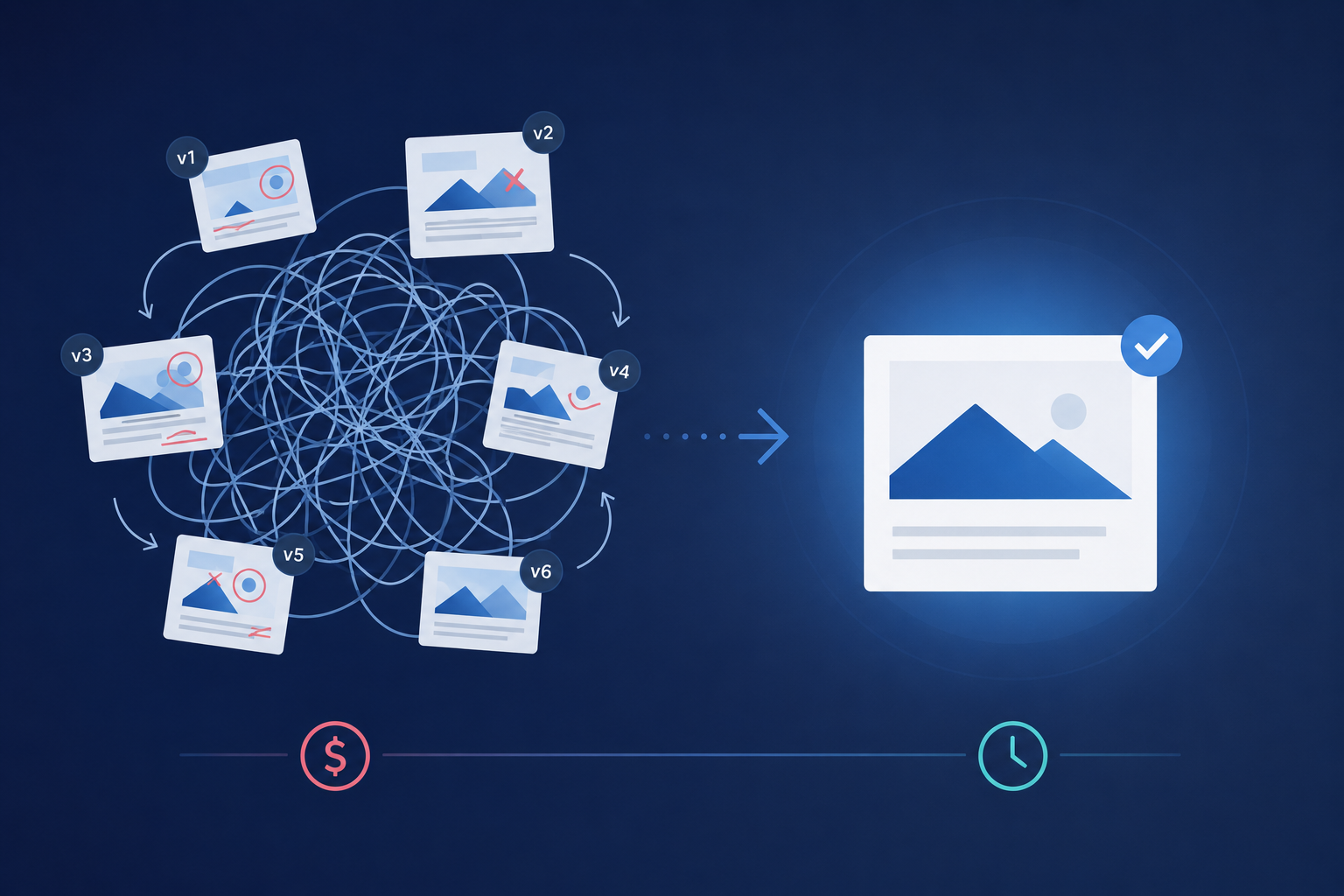
Why Design Revisions Spiral Out of Control
A design revision is any change made to an asset after the first draft. Revisions are essential — they're how creative work gets to "right." The problem is the excessive kind: the round you could have avoided, the change that contradicts last week's change, the version someone marked up that turned out to be old. Most runaway revisions trace back to one of two causes:
Process problems. Approvals are scattered across email, chat and shared drives. There's no defined order of who reviews when, so feedback arrives out of sequence — or reviewers comment on a version that's already been superseded. The work is sound; the pipeline carrying it isn't.
Feedback problems. Comments are vague, fragmented or contradictory. Reviewers can't see what others have already said, so they duplicate notes or pull the work in opposite directions. Designers are left guessing what the client or stakeholder actually meant, which guarantees another round.
Both are communication failures — and both are fixable with the right system, not just a better conversation.
Process Problem or Feedback Problem? How to Tell
Before you can reduce revisions, you need to know which of the two is driving them. The symptoms are distinct.
You have a process problem if:
- Reviewers are commenting on different versions of the same asset, and you're not sure which is current.
- Approvals come in over email, chat and verbally, with no single record of who signed off.
- Feedback arrives out of order, so a change gets made, then reversed by a note that came in late.
- You're manually chasing stakeholders for sign-off one at a time.
You have a feedback problem if:
- Comments are vague — "make it pop", "not quite right" — with no reference to a specific element.
- Two reviewers ask for contradictory changes because neither can see the other's notes.
- The same point gets raised repeatedly across rounds because earlier feedback wasn't visible or recorded.
- Designers routinely go back to ask what a piece of feedback actually meant.
Process problems are solved by structure: one current version, a defined review order, and a single record of approvals. Feedback problems are solved by context: comments pinned to the exact part of the asset, visible to everyone reviewing. Online proofing software addresses both at once, which is why it's the most direct way to bring revision cycles down.
The Hidden Cost of Endless Revisions
Every extra revision round has a price, and it compounds. There's designer time spent reworking instead of creating. There are external hours — freelancers and contractors billing for changes that clearer feedback would have prevented. There's the delay to campaign launch while an asset bounces back and forth. For print work, there are reprint costs. And underneath all of it is the morale cost: nothing wears a creative team down faster than rework that felt avoidable. Reducing revisions isn't a nicety — it's one of the clearest efficiency gains available to a marketing or creative team.
How Online Proofing Software Reduces Design Revisions
Because excessive revisions come from broken process and unclear feedback, the fix is a system that structures both. Online proofing software does this in four ways:
Centralised, contextual feedback. All comments live in one place, attached directly to the part of the asset they refer to. Every reviewer sees what others have already said, so feedback stops being duplicated or contradictory — and designers know exactly what to change before they touch the file. Clearer input the first time means fewer rounds.
One current version, every time. Automatic version control means reviewers always open the latest file, not last week's. Side-by-side comparison makes it easy to confirm that every requested change was actually made — killing the "version sprawl" and dated-version reviews that trigger needless rework.
Structured approval routing. Instead of chasing sign-offs one person at a time, assets move through a defined sequence of reviewers automatically. No approval gets skipped, no stage gets revisited because someone was missed the first time.
Accountability and a clear record. When every comment, change and approval is logged in an audit trail, there's no relitigating decisions that were already made — a common and entirely avoidable source of extra revisions.
Reducing Revisions with Simple Admation
Simple Admation is a marketing approval workflow platform with built-in online proofing that gives in-house marketing teams and agencies one place to review, mark up and approve every asset. Because proofing sits inside the wider approval and project workflow rather than beside it, the conditions that create excessive revisions simply don't arise.
- Admation's markup and annotation tools let reviewers pin precise feedback to the exact element of an asset, so notes are never vague or lost.
- Admation's four version-comparison modes — side-by-side, swipe, overlay and pixel contrast — make it obvious what changed between revisions and confirm every change was applied.
- Admation's approval routing sends each asset through creative, brand, legal and client reviewers in a defined order, removing the scattered sign-offs that cause rework.
- Admation's audit trail records every comment and approval with a timestamp and named individual, so decisions stay decided.
It's used by teams in financial services, insurance, health, retail and agency environments — anywhere revision cycles, accuracy and speed to market matter. If you're weighing up your options, our guide to the best online proofing software compares how the leading platforms handle review and approval.
How to Reduce Design Revisions: Practical Steps
Whether or not you adopt a dedicated platform, these steps cut revision rounds:
- Brief clearly upfront. Most revision loops start with an unclear or mismatched brief. Agree objectives, scope and what "done" looks like before work begins.
- Collect all feedback in one place, on the asset. Stop feedback living across email and chat. Consolidated, contextual comments prevent the duplicated and contradictory notes that trigger extra rounds.
- Make sure everyone reviews the current version. A single source of truth for the latest file removes dated-version reviews entirely.
- Route approvals in a defined sequence. A clear approval and audit path means no stage is skipped and no sign-off is chased manually.
- Agree revision rounds as part of scope. Setting expectations on how many rounds a project includes encourages reviewers to make each one count.
Bring Your Revision Cycles Under Control
Endless design revisions are rarely a people problem — they're a process problem, and process problems are fixable. Simple Admation brings proofing, version control and structured approvals into one platform so feedback is clear, versions are certain, and rework is the exception rather than the rule.
Frequently Asked Questions
What causes too many design revisions?
Excessive design revisions usually come from one of two sources: process problems and feedback problems. Process problems include scattered approvals, no defined review order, and reviewers working from outdated versions. Feedback problems include vague, fragmented or contradictory comments, often because reviewers can't see what others have already said. Both are communication failures in how work moves through a team, rather than a sign of a difficult client.
How does online proofing software reduce design revisions?
Online proofing software reduces revisions by centralising all feedback on the asset itself, so comments are clear and never duplicated or contradictory, and by keeping every reviewer on the current version with automatic version control. Structured approval routing ensures the right people review in the right order, which removes the rework caused by missed or out-of-sequence sign-offs. Clearer feedback and certain versions mean changes are made correctly the first time.
How do teams reduce review errors with online proofing?
Teams reduce review errors by pinning feedback to the exact element of an asset, comparing versions side by side to confirm every change was made, and routing assets through mandatory approval stages so nothing reaches final sign-off unchecked. A complete audit trail records who approved what and when, which catches discrepancies between what was approved and what was delivered before they become live errors. Platforms such as Simple Admation combine online proofing, version comparison and an audit trail in one approval workflow, so these safeguards work together rather than across separate tools.
How many rounds of revisions should a project need?
There's no universal number, but most projects build two to three review rounds into scope. The exact figure matters less than agreeing it upfront and structuring the process so each round is productive. When feedback is clear and contextual and everyone reviews the current version, projects consistently need fewer rounds than teams relying on email and scattered approvals.
Can reducing design revisions lower project costs?
Yes. Each avoided revision round saves designer time, reduces external and freelance hours, shortens time to market, and cuts reprint costs for print work. For teams producing high volumes of creative, the cumulative saving from fewer revision rounds is significant — which is why reducing revisions is one of the clearest efficiency gains a marketing or creative team can make.


