

campaign can have plenty of approvals and still be difficult to explain six months later. The final sign-off sits in an email, the agency has a different file, and nobody can confirm whether the published version includes the changes requested by compliance.
How do you build an audit-ready marketing compliance workflow?
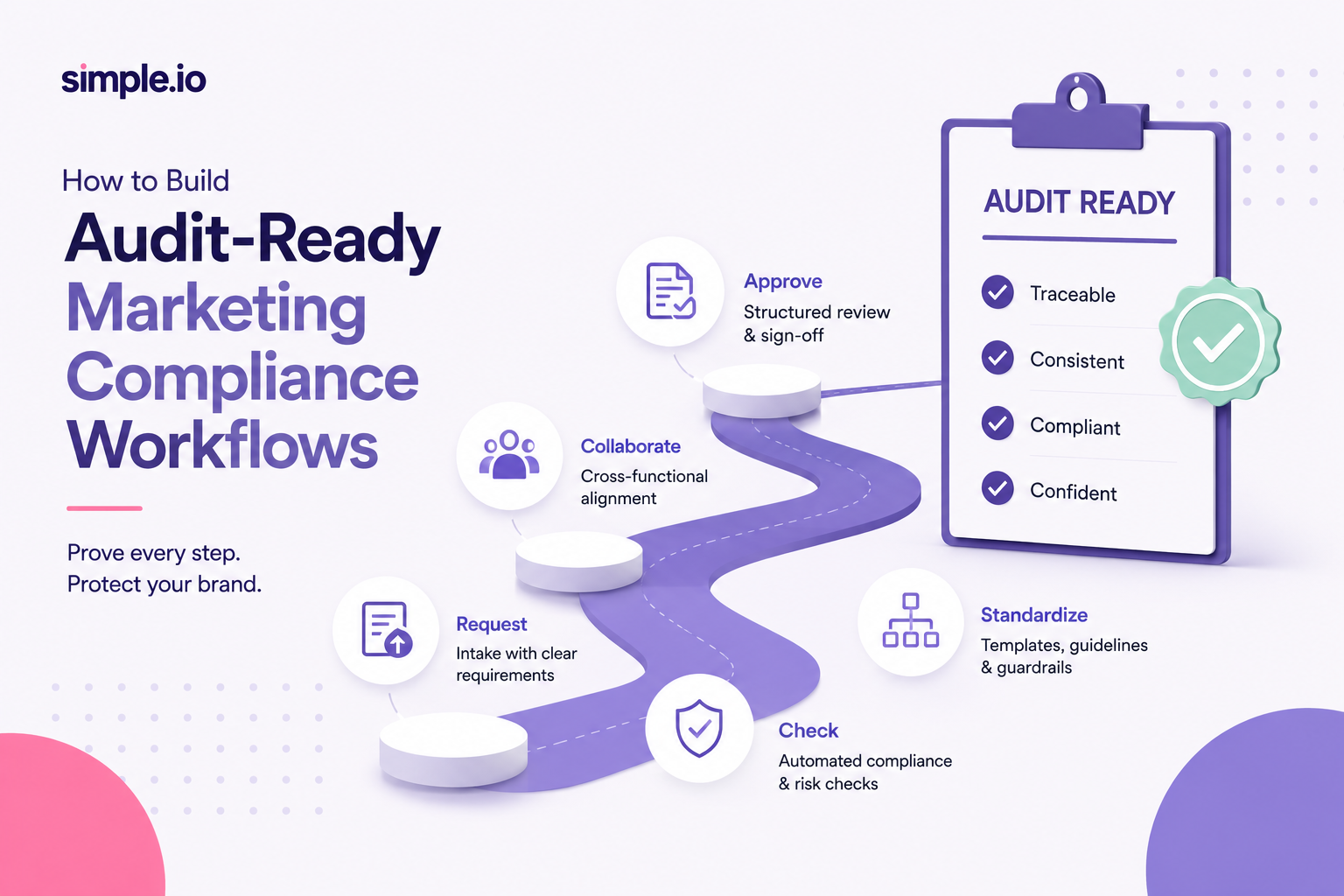
Build it in eight steps: capture requirements in the brief, set review pathways by risk, assign owners and escalation, link every decision to a specific version, define what triggers reapproval, verify the release against the approved version, set retention rules, and test the process by reconstructing a past campaign.
An audit-ready marketing compliance workflow connects the brief, asset versions, feedback, approval decisions and release records. It helps teams show what was reviewed, who made each decision and which material went to market.
For enterprise marketing teams, the aim is to make that record part of everyday work. Marketing compliance software should support the creative process while helping teams retain the information needed for later review.
Simple Admation is Simple’s marketing project management and approval platform. This guide explains how to design the process and where software can support it, from the first brief through to final sign-off and record retrieval.
What makes a marketing workflow audit-ready
For an overview of Australian obligations and how to structure a compliance process, see our complete guide to marketing compliance. An audit-ready marketing workflow is a documented process that retains a traceable record of the required reviews, decisions and approved versions for each marketing deliverable. It also connects those approvals to release information and the organisation’s recordkeeping requirements.
A useful record should let someone who was not involved in the campaign understand what happened. They should be able to identify the applicable review pathway, see how feedback was resolved and distinguish an approved version from an earlier draft.
Audit readiness supports internal governance and regulatory compliance. It does not guarantee that content meets every applicable obligation. The quality of the review, the suitability of the controls and the completeness of the records still matter.
Why a marketing approval process may not be audit-ready
The gaps often appear between activities rather than within a single approval stage. A reviewer gives clear feedback, but the response is not recorded. An asset receives sign-off, but a later edit is released without another review.
Use this checklist to identify where your process needs attention.
| Process gap | Practical fix |
|---|---|
| Approvals are spread across email and chat | Keep review decisions in the agreed project record |
| A sign-off does not identify the asset version | Associate each approval with a specific deliverable and version |
| Review responsibilities change from job to job | Document required reviewers by content type and risk |
| Feedback is marked complete without explanation | Record the revision or reason for accepting another approach |
| Content changes after approval | Define which changes require another review |
| Nobody checks what was released | Assign an owner to verify the publication or distribution handover |
| Records are difficult to access after staff leave | Establish shared access and retention arrangements |
Prioritise gaps that make it difficult to show whether the required review occurred. Adding more approvers will not resolve missing version information or incomplete release records.
How to build an audit-ready marketing compliance workflow
Step 1: Define the requirements in the brief
Start with the information reviewers need to make a decision. Record the campaign objective, audience, product or service, channels, deliverables, publication dates and responsible owner.
Include relevant review requirements, such as product accuracy, brand guidelines, disclosures, image permissions or accessibility standards. Attach supporting documents where they are needed. A claims library may help some teams, but many campaigns also depend on current product terms, approved messaging, usage rights and clear instructions.
Agree the applicable obligations with the appropriate internal specialists. A financial services promotion, retail offer and healthcare campaign may require different checks. Avoid copying one checklist across every type of content.
Step 2: Set review pathways according to risk
Risk-based approval workflows give different content types the level of review they need. They also help creative operations teams manage volume without sending every asset through the same sequence.
Develop the pathways with marketing, product, legal and compliance stakeholders. The examples below are starting points for discussion, not prescribed approval requirements.
| Content category | Example | Review approach to agree |
|---|---|---|
| Routine | An unchanged approved template with updated event details | Check permitted changes, accuracy and brand presentation |
| Product or promotional | A new offer, product email or campaign landing page | Include relevant product and compliance specialists |
| Higher risk | A new financial promotion or sensitive public statement | Involve specialists early and define final release authority |
Consider the audience, jurisdiction, channel, novelty and potential impact when assigning risk. A small asset can still carry a significant risk if its wording changes the meaning of an offer.
Decide which reviews can happen together and which depend on an earlier decision. Product accuracy and brand review may run in parallel, while a final compliance decision may need the revised copy and layout.
Step 3: Define ownership and escalation
Assign a project owner, required reviewers and the person responsible for release. Make the scope of each approval clear: a design sign-off should not be mistaken for confirmation of product terms.
Set review deadlines and an escalation route for delays. When an approver is unavailable, use an authorised substitute and record the delegation. Keep the original review requirement visible so a change of personnel does not remove a required check.
For urgent campaigns, agree an exception process in advance. Record who authorised the exception, its scope, the reason and any follow-up actions. Urgency should be visible in the record rather than becoming an undocumented shortcut.
Step 4: Keep feedback and decisions connected to versions
Give each deliverable a clear identity and retain the versions used during review. Reviewers should know which file they are assessing, and the project owner should be able to show how requested changes were addressed.
Consolidate feedback before briefing the next revision. If reviewers disagree, record the resolution and who made the decision. Keep substantive feedback attached to the relevant asset rather than relying on a separate conversation that future reviewers cannot access.
An approval decision should identify the reviewer, date, version and outcome. Where a decision has conditions or limitations, record those as well.
Step 5: Define what triggers another approval
Agree how changes after sign-off are assessed. Changes to prices, eligibility, disclosures, product details, imagery, audience or channel may affect the original approval.
Specify who decides whether another review is required and which reviewers need to participate. Even a layout change may matter if it makes a disclosure harder to read or separates it from the offer.
Do not assume approval of one asset covers every adaptation. Each deliverable needs an identifiable approval status, including versions created by agencies and external partners.
Step 6: Verify the release handover
Approval evidence shows what was authorised. Publication evidence shows what was actually used. A complete process connects the two.
Assign someone to check the released material against the approved version. Depending on the channel, retain a published PDF, dated screenshot, URL, print proof or distribution record. Record relevant publication dates and any review or withdrawal dates.
If content moves into a CMS, CRM or email platform, preserve a reference back to the approved deliverable. Confirm how edits made in that destination system will be reviewed. Workflow controls inside approval software do not automatically control every external publishing channel.
Step 7: Set retention and access rules
Agree how long records must be retained with the organisation’s legal, compliance and information governance teams. Requirements may differ across content types, jurisdictions and contractual arrangements.
Define who can access historical projects, how records are protected from inappropriate changes and what happens when users leave. Check how archived records can be retrieved and what information remains available following a system migration or contract termination.
Step 8: Test the process with a past campaign
Choose a campaign published six months ago and ask someone outside the original team to reconstruct its approval history.
Can they identify the final approved files, required reviewers, decisions, material changes and release records? Can they retrieve supporting documents and understand any exceptions?
Set a retrieval target that fits your organisation’s needs. Speed matters, but a quick response containing incomplete records is not a successful test. Use missing information and access problems to improve the workflow.
How to scale an audit-ready workflow across brands, teams and agencies
Enterprise teams rarely run one workflow. Several brands, business units and agencies produce content at once, and each group tends to develop its own approach. An audit-ready programme keeps one governance model and lets each team apply it to its own content.
| Governance element | What to standardise |
|---|---|
| Pathway library | Approved review pathways by content type and risk, maintained by one owner |
| Templates | Brief and approval templates that carry the required checks into every new project |
| Agency onboarding | How external partners submit work, label versions and receive feedback |
| Performance review | Quarterly review of cycle time, reapprovals, exceptions and retrieval test results |
What should a marketing approval record contain
A useful approval record connects the following information at campaign and deliverable level.
| Record | What it should establish |
|---|---|
| Brief and requirements | Purpose, audience, channels, responsibilities and relevant checks |
| Review pathway | Required reviewers and the scope of their decisions |
| Reviewed versions | The material assessed at each stage |
| Feedback and resolutions | Issues raised and how they were addressed |
| Approval decisions | Who approved or rejected which version and when |
| Supporting documents | Relevant terms, guidelines, permissions or substantiation |
| Final approved material | The specific files authorised for release |
| Release information | What was published or distributed, where and when |
| Exceptions and later changes | Delegation, authorised exceptions and subsequent reviews |
| Retention and access arrangements | How the connected record remains available |
The record may span more than one system. What matters is that the links are reliable, access is controlled and the information can be retrieved together without relying on someone’s memory.
Example of a financial services campaign approval workflow
Consider an illustrative campaign promoting an insurance product through an email, landing page and brochure. This is a process example, not a customer case study or a prescribed regulatory pathway.
The campaign owner prepares a brief covering the audience, offer, product information, channels and launch date. Product and compliance specialists agree the required reviews and identify any disclosures or wording that need particular attention.
| Stage | Team activity | Record retained |
|---|---|---|
| Brief | Agree scope, requirements and responsibilities | Brief and review pathway |
| Draft review | Assess product accuracy, presentation and relevant compliance issues | Asset versions and reviewer feedback |
| Revision | Resolve comments and compare updated material | Revised versions and explanations |
| Final approval | Confirm required sign-offs for each deliverable | Version-specific approval decisions |
| Release | Check the email, live page and brochure against approved material | Release copies and publication details |
| Later review | Retrieve the connected campaign history | Complete approval record |
During review, the compliance approver takes leave. An authorised substitute completes the review, with the delegation recorded. The agency uploads a revised brochure, which is identified as a new version rather than replacing the earlier review record.
After final approval, the product team changes an eligibility statement. The campaign owner checks the agreed reapproval rules and returns the affected deliverables to the relevant reviewers.
The email is ready before the landing page. Its approval remains identifiable, but the campaign owner checks whether the email can be released before its destination page is ready. Approval status and release readiness are separate decisions.
Applying the same approach to direct mail
For a direct mail campaign, identify the approved artwork and final print-ready file. Retain the relevant print proof, confirmation of the version supplied to the printer and distribution details.
If variable content is used, document which fields can change and how those changes are checked. Recipient data, consent and suppression controls should be handled through the organisation’s approved data processes, with relevant references connected to the campaign where appropriate.
How Simple Admation supports the creative approval process
Simple Admation is marketing approval and compliance software that connects creative briefing, project management, online proofing and multi-level approvals in one platform for enterprise and regulated marketing teams. Customisable online briefs capture project requirements, while approval templates, checklists and role-based permissions structure each review pathway.
Reviewers annotate assets, consolidate feedback and compare revisions side by side. Version control and approval history connect each comment, change and decision to the deliverable it relates to, so teams can retrieve how a campaign was reviewed.
AI Compliance Checking adds a first-pass review against the rule sets administrators configure. Checks run automatically when an asset is submitted and can also be run on demand. Findings are shown to approvers on the approval page; approvers decide which findings become annotations on the asset, and the approval decision remains a human record.
Learn about marketing approval audit trails.
The organisation still needs to define its pathways, reviewer responsibilities, release checks and retention rules. Confirm how the proposed configuration supports those requirements during evaluation and implementation.
What to ask marketing compliance software vendors to demonstrate
When comparing enterprise compliance tools, ask vendors to walk through a realistic campaign rather than presenting a feature list.
Use a scenario with multiple deliverables, an external agency, an absent reviewer and a change after approval. Ask the vendor to demonstrate:
- How required reviewers and permissions are configured.
- How feedback and approval decisions connect to a specific version.
- What happens when an approved asset changes.
- How delegation and exceptions appear in the record.
- How historical records are searched, retrieved and exported.
- Which export formats and record details are available.
- Who can change or delete records and how those actions are logged.
- How retention, access and external publishing handovers are handled.
If AI-assisted checking is available, assess how rules are maintained, findings are reviewed and human decisions are recorded. An automated check can support review; it should not be treated as evidence that every obligation has been satisfied.
Marketing compliance software is most useful when its controls match the process the team has agreed to follow. Evaluate workflow fit alongside security, implementation, integration and recordkeeping requirements.
For software selection guidance, read how to choose marketing compliance software in Australia.
Frequently asked questions
How do you test a marketing workflow before an audit request arrives?
Select a completed campaign and ask a colleague who was not involved to reconstruct its review and release history. Check whether they can identify the required pathway, explain how material feedback was resolved and connect the approved deliverables to what went to market. Record missing information, access problems and retrieval time, then fix the gaps and repeat the test.
How should approvals be documented when campaign assets launch on different dates?
Maintain an approval status and release record for each deliverable, rather than treating the campaign as a single approved item. Record which version was cleared, its release date and any dependencies, such as an email linking to a landing page. The campaign owner should confirm that each asset is both approved and ready for its planned release.
What should happen when an agency changes an asset after final sign-off?
Retain the approved version and identify the agency’s update as a new revision. Assess the change against the organisation’s reapproval rules, record who made that assessment and route the affected material to the required reviewers. Confirm that the release team receives the version authorised for publication, including any updated files supplied to printers or media partners.
How can a marketing team verify that published content matches the approved version?
Assign a release owner to compare the live or distributed material with the approved deliverable. Retain channel-appropriate evidence, such as a dated screenshot, published PDF or final print proof, and link it to the approval record. If the material differs, document the difference and apply the agreed correction or review process.
How should urgent approval exceptions be recorded in the workflow?
Record the reason for the exception, the affected deliverables, who authorised it, the review steps involved and any conditions or follow-up actions. Keep that record with the campaign so a later reviewer can distinguish an authorised exception from an unexplained gap. An exception process must stay within the organisation’s agreed authority and applicable requirements.
How do you keep approval records understandable after the project team changes?
Use consistent campaign and deliverable references, shared record locations and clearly named versions. Document the scope of decisions and the resolution of important comments rather than relying on personal knowledge. Assign ownership for archived records and review access when staff or agency contacts change, so an authorised colleague can retrieve and interpret the history.
Does AI compliance checking create an audit record?
In Simple Admation, AI Compliance Checking findings are shown to approvers during review rather than stored in the audit trail as decisions. The audit record captures what approvers do: the annotations they raise, the versions they assess and the approval decisions they make. AI supports the review, but the documented human sign-off remains the evidence that the required check took place.
Put the workflow into practice
Start with one campaign type. Agree its review pathway, define what the approval record must contain and test how the final material moves into market. Use the first completed campaign to identify gaps before extending the process across other teams and channels.
See how your team can connect creative projects, feedback and marketing approvals in one workflow. Watch a demo or book a demonstration, and bring a typical campaign so the discussion can focus on your review and recordkeeping requirements.


