
A PIM (Product Information Management) system manages your product data — descriptions, images, specs, pricing and attributes — and distributes it consistently across every sales channel. A DAM (Digital Asset Management) system manages your digital files — photography, video, brand guidelines and creative assets — so teams can find, use and share them efficiently. One manages what you say about a product; the other manages what you show. Simple Retailpath is the PIM in the Simple suite, and Simple Asset Manager is the DAM — built to work together.
Why retail and e-commerce teams confuse the two
It's a common point of confusion — and understandably so. Both PIM and DAM systems deal with product content, both live at the centre of your marketing and sales operations, and both are designed to bring order to large volumes of information. If you're managing thousands of SKUs across multiple retailers and channels, the line between 'product data' and 'product assets' can feel blurry.
But once you understand what each system is actually built to do, the distinction becomes clear.
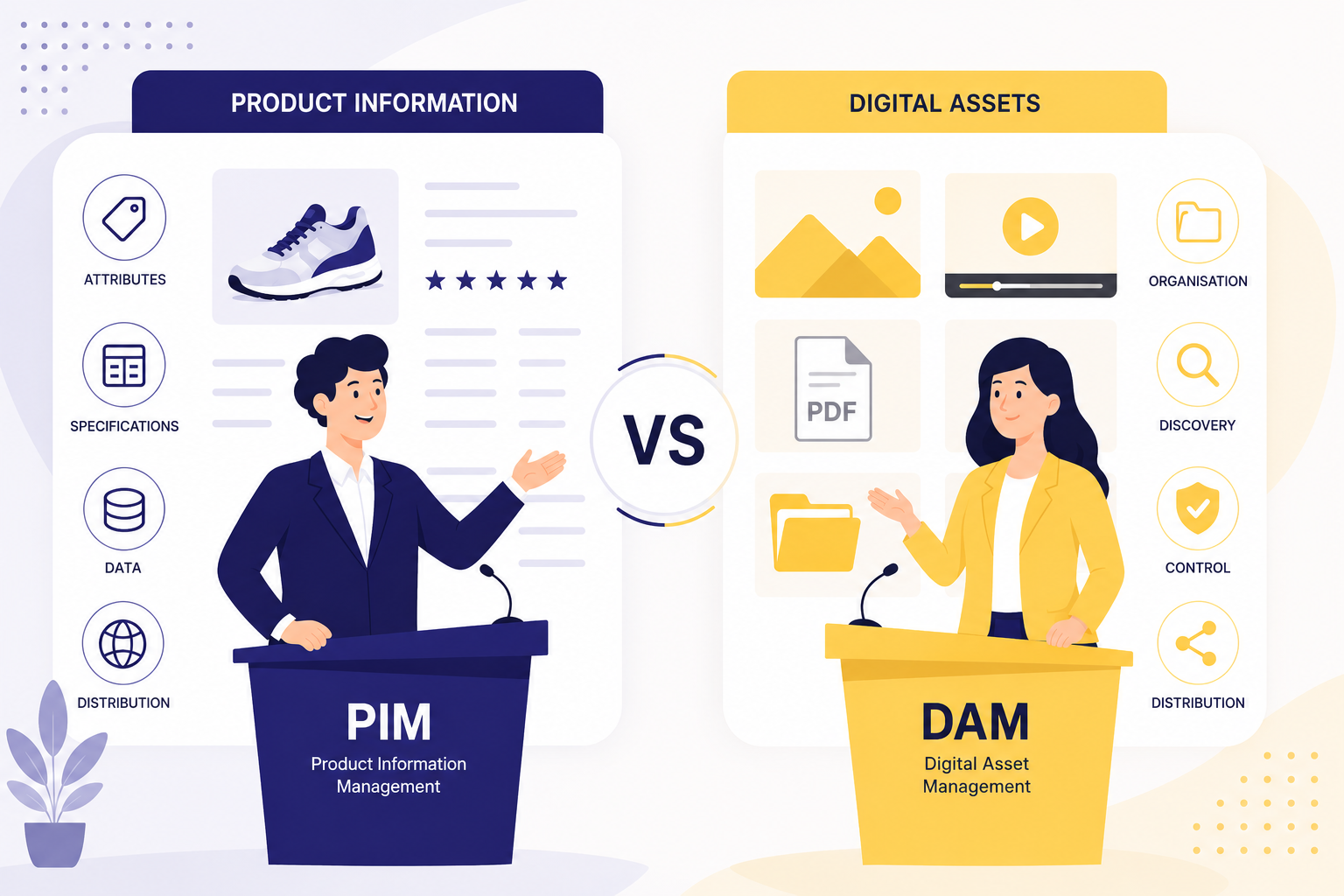
What is a PIM system?
A PIM system is the single source of truth for your product information. It's where you store, manage, and distribute everything that describes a product — not just for your website, but for every channel it appears on: online marketplaces, retailer portals, print catalogues, in-store systems, and more. For a full explanation of how PIM works end to end, see what is PIM software.
What a PIM manages:
- Product names, descriptions, and long-form copy
- Technical specifications and attributes
- Pricing and promotional data
- Category and taxonomy structures
- Channel-specific product variants
- Localisation and language variations
The core problem PIM solves:
Without a PIM, product data tends to live in spreadsheets, ERP systems, and email chains. When you need to update a description or push new pricing to ten different channels, it becomes a manual, error-prone process. A PIM centralises that data and automates distribution, so your product information is always accurate and consistent wherever customers encounter it.
Who typically needs a PIM:
- Retailers managing large and complex product catalogues
- Manufacturers supplying product data to multiple retailers or distributors
- E-commerce teams selling across multiple platforms (own site, Amazon, eBay, retail partner portals)
- Businesses that frequently update product ranges or pricing
Simple Retailpath is a retail PIM platform built specifically for retail marketing teams — managing product content from creation through to channel distribution, with integrated promotion production for catalogues and eDMs. See the Simple Retailpath product information management solution for full capabilities.
What is a DAM system?
A DAM system is the single source of truth for your digital files. It's where your team stores, organises, and accesses brand assets — from hero product photography to campaign videos to approved brand logos — so the right asset is always easy to find and use.
What a DAM manages:
- Product photography and lifestyle imagery
- Video content and animations
- Brand guidelines and style assets
- Marketing campaign creative files
- Approved templates and artwork
- Version histories and usage rights
The core problem DAM solves:
Without a DAM, digital assets are typically scattered across shared drives, inboxes, and personal folders. Teams waste time searching for files, accidentally use outdated imagery, or distribute unapproved assets. A DAM brings all of that into one secure, searchable library with proper access controls and version management.
Who typically needs a DAM:
- Marketing teams managing large volumes of visual content
- Brands with multiple agencies or external partners who need access to assets
- Retail businesses running frequent campaigns with high creative output
- Any team where "can you send me the latest version of that image?" is a daily occurrence
Simple Asset Manager is a digital asset management platform that gives retail and marketing teams a centralised home for all their digital and brand assets, with smart search, permissions management, and seamless sharing. Learn more about Simple Asset Manager.
PIM vs DAM: A direct comparison
|
|
PIM |
DAM |
|
Primary focus |
Product data and information |
Digital files and creative assets |
|
What it stores |
Text, specs, pricing, attributes |
Images, video, documents, brand files |
|
Key benefit |
Consistency across sales channels |
Efficiency in asset access and distribution |
|
Core users |
E-commerce, product, and merchandising teams |
Marketing, creative, and brand teams |
|
Typical trigger |
Managing many SKUs across multiple channels |
Managing large volumes of creative content |
|
Integrates with |
ERP, e-commerce platforms, retailer portals |
CMS, creative tools, marketing platforms |
How to decide which one you need
Ask yourself these questions:
You likely need a PIM if:
- You manage hundreds or thousands of SKUs
- Your product data is inconsistent across different sales channels
- Updating product listings is a slow, manual process
- You supply product content to external retailers or marketplaces
- Product launches are delayed because data isn't ready or approved
You likely need a DAM if:
- Your team regularly struggles to find the latest version of an image or asset
- You're working with multiple agencies or external partners who need brand files
- Creative assets are spread across shared drives, email, and Dropbox
- You're spending too much time managing asset requests
- Unapproved or outdated assets are being used in market
You may need both if:
- You're a mid-to-large retailer managing both complex product catalogues and high-volume creative output
- You have separate teams responsible for product data and brand/marketing content
- You want product information and associated imagery to stay aligned as products change
Using PIM and DAM together
For many retail businesses, PIM and DAM aren't an either/or decision — they're complementary systems that work best in combination. When integrated, your product data (managed in PIM) and your product imagery (managed in DAM) stay connected and consistent, so when a product changes, both the information and the assets update in sync across your channels.
This integration is particularly valuable for retailers managing seasonal ranges, frequent product refreshes, or high-volume promotional activity where speed and accuracy across channels directly impacts revenue. For how this connects to the full retail workflow — vendor onboarding, enrichment, approval and promotion production — see the complete guide to PIM for retail.
See How Retailpath and Asset Manager Work Together
Simple Retailpath and Simple Asset Manager are designed as complementary platforms — product data and product assets, connected and consistent across every channel. See how they fit your product content workflowW Book a Demo
Frequently Asked Questions
What is the main difference between PIM and DAM?
A PIM manages structured product data (descriptions, specs, pricing), while a DAM manages digital files (images, video, brand assets). PIM is about what you say about a product; DAM is about what you show.
Can a DAM replace a PIM?
No. A DAM is not designed to manage product attributes, pricing, or channel distribution logic. It stores and organises files, but doesn't handle the structured data that drives product listings across sales channels.
Can a PIM replace a DAM?
Some PIM systems include basic asset storage, but they're not built for the advanced search, version control, rights management, and creative workflows that a dedicated DAM provides. For businesses with high creative output, a DAM is still the right tool for managing assets.
Do small retailers need a PIM or DAM?
It depends on your pain points. A small retailer with a limited product range but heavy campaign activity might benefit more from a DAM first. A small retailer selling across multiple platforms with complex product data may need a PIM sooner. The best starting point is identifying where your biggest operational friction is.
Should I implement a PIM or a DAM first?
Start with the system that addresses your biggest source of operational friction. If inconsistent product data across channels is costing you sales, corrections and delayed launches, implement the PIM first. If your teams lose more time hunting for assets and using outdated creative, start with the DAM. Many retailers implement one, prove the workflow, then add the other — choosing platforms that integrate from the outset avoids re-work when the second system arrives.
Can Simple Retailpath and Simple Asset Manager be used together?
Yes. Simple Retailpath is a PIM built for retail teams, and Simple Asset Manager is a DAM for digital and brand assets. They are designed to work together as part of one suite for end-to-end product content management — product records in Retailpath and their associated media in Asset Manager stay in sync as products change.